
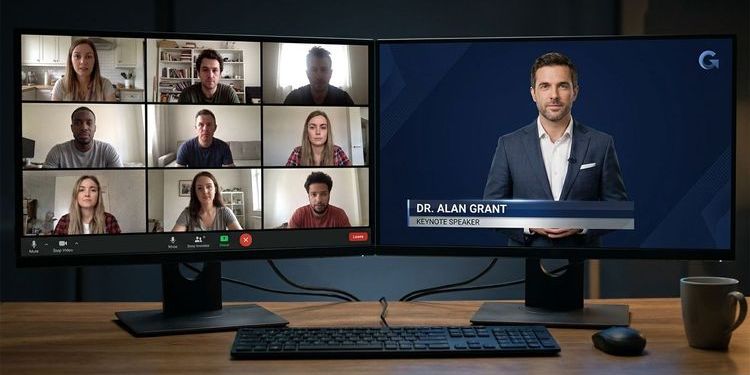
Zoom is the most widely recognised webinar tool in the DACH market — and for good reason. But for professional webcasts, this default choice falls short. Zoom was built for bidirectional meetings, not broadcasts. Teams planning CEO townhalls, streaming earnings calls for investors, or producing marketing events with full CI branding hit limits baked into the platform's core architecture — limits no software update will fix. Evaluating a Zoom alternative is, in these cases, not a matter of preference but of requirements.
This article maps exactly where those limits are, when Zoom remains the right choice — and when a GDPR-compliant webcast platform made in Germany is the superior option.
Why Zoom Webinars and professional webcasts are fundamentally different
Zoom is a good meeting tool — that is a technical observation, not a PR talking point. Its core architecture is optimised for low latency so that two-way conversations feel natural. Zoom Webinars is not a standalone product; it is an add-on built on top of that same meeting infrastructure.
Broadcast production requires something different: a platform designed for maximum stability and high bitrate, with host-side redundancy for connection failures and professional production control without external technical overhead. Full CI branding and redundant encoder setups are baseline features on a dedicated webcast platform — not retrofitted add-ons.
Context: Zoom Webinars works well for internal events with manageable audience sizes and no strict branding or compliance requirements. As soon as external stakeholders, CI demands, or GDPR criticality enter the picture, a closer look at specialised alternatives is worthwhile.
Further reading: Webinar vs. webcast: the comprehensive guide
Four structural limits that surface in professional events
1. Branding: Zoom is always visible
Zoom has improved with "Session Branding": wallpapers, nametags, logo placement, and panelist display are all configurable. For many internal use cases, this is sufficient. For external events, it is not.
Join screens, registration pages, and email templates all carry Zoom's visual identity. Professional lower thirds, virtual studios, or full CI control over the live stream still require an external encoder such as OBS or Blackmagic — considerable technical overhead that most teams cannot or do not want to manage.
When Commerzbank streams an earnings call for investors, the audience should see Commerzbank — not a Zoom wallpaper with a logo. What works internally often falls short when external stakeholders are watching.
Further reading: MEETYOO branding features
2. Q&A management: when hundreds of questions arrive simultaneously
This is the gap most often underestimated until it happens live.
Imagine an all-hands with 500 employees. The CEO takes questions. Within 20 minutes, 200 questions have come in. Zoom offers upvoting — attendees can push questions up the list. But there is no automatic topic categorisation, no way to assign individual questions to a specific speaker, and multiple moderators share the same queue without role separation. The result: the team works against the interface, not with it. Relevant questions get buried.
This is not an edge case at 10,000-attendee events — it is the reality at ordinary mid-market townhalls.
Further reading: MEETYOO engagement features
3. GDPR: the residual risk is structural
Zoom Video Communications, Inc. is a US company. Data transfer to the United States is structurally unavoidable when using the platform. The EU–US Data Privacy Framework (DPF) currently provides the legal basis for that transfer — but it remains fragile.
The DPF is the third data transfer agreement after Safe Harbor (CJEU 2015, Schrems I) and Privacy Shield (CJEU 2020, Schrems II). The EU General Court confirmed it at first instance in September 2025. However, the DPF rests not on an act of parliament but on a presidential executive order from the previous US administration — whose political continuity is not guaranteed. Max Schrems' organisation NOYB has filed complaints that could again reach the CJEU.
datenschutz.org notes (as of April 2026): "Total GDPR compliance does not exist, as data transfer to the US takes place and thus a legal residual risk remains."
The US CLOUD Act adds further exposure: it legally obligates US companies to hand over data on government request — regardless of where that data is physically stored. Heise Online concludes, following a legal analysis, that US authorities have extensive access to data held in European data centres as long as the provider is a US company. According to a representative ESET survey (October 2025), three in four German companies looking to switch their IT security provider prefer EU-based vendors — US providers are trusted by only 10 percent.
Further reading: The GDPR trap: why your webinar tool choice determines your data protection
4. Content ROI after the webinar: what happens to the event
Zoom AI Companion has made genuine advances in 2025/2026: post-event summaries for hosts, transcript download for admins, and the ability to generate various content types from recordings. This is real progress.
Yet Zoom still delivers a recording and a separate transcript. There is no natively embedded, searchable archive. Attendees cannot ask questions directly to the recording after the event. Anyone who wants to extract content value from a webcast beyond the live moment handles that manually with Zoom.
What makes the difference: A Zoom webinar produces a recording with a summary. A MEETYOO webcast produces a searchable on-demand archive with automatic chapter markers — and attendees can ask questions directly to the video weeks later and receive an answer with a timestamp link.
Further reading: More than a transcript: how AI genuinely maximises your webcast ROI
What Zoom Webinars genuinely does well
The scale is unmatched: up to one million attendees (single-use licence, since 2024) — no other provider comes close. Everyone knows Zoom; the participation barrier is minimal, with no installation or onboarding required. The CRM ecosystem — HubSpot, Salesforce, Marketo — is mature. Zoom is stable even on poor connections. Teams already using Zoom Workplace pay modest incremental costs for occasional webinars, and for exactly that use case Zoom remains the natural choice.
When Zoom is enough — and when a Zoom alternative in Germany pays off
| Scenario | Description | Zoom Webinars | MEETYOO Show |
|---|---|---|---|
| A — Internal events | <200 attendees, no branding, occasional | ✅ Sufficient | Overkill |
| B — Marketing events | External attendees, CI requirements, 500+, regular | ⚠️ Limited | ✅ Better fit |
| C — Enterprise events | CEO townhall, earnings call, GDPR-critical | ❌ Structurally unsuitable | ✅ Built for this |
Scenario A — internal all-hands, training sessions, team demos with no external stakeholders: Zoom is sufficient; switching would be disproportionate.
Scenario B — external marketing webinars, lead generation, customer events: Zoom works, but with noticeable compromises on branding, Q&A management, and content ROI.
Scenario C — CEO townhalls, earnings calls, compliance training in regulated industries: branding, failover, GDPR compliance, and sustainable content reuse are prerequisites here, not options.
The simple rule: As soon as external stakeholders are attending, your brand needs to be visible on the stream, or you want to extract value from the event after the live moment — a specialised broadcast platform pays for itself. Zoom was built for meetings. Professional webcasts need a different foundation.
MEETYOO Show: GDPR-compliant webcast platform made in Germany
Built from the ground up as a broadcast platform
MEETYOO Show is not meeting software with a webinar extension. The platform was developed for broadcasts — with a focus on failover reliability, high bitrate, and professional production readiness.
Failover: what happens when the stream drops
With Zoom, there is no host-side backup encoder. If the stream goes down, it stays down — until the team manually restores the connection, typically 60 to 90 seconds of outage in front of 1,500 viewers.
MEETYOO Show uses redundant encoder setups as standard. Primary and backup run in parallel. If the main stream fails, the backup takes over without interruption — invisible to viewers, without manual intervention. On an earnings call with 3,000 investors or a CEO townhall with 2,000 employees, this is not a technical detail; it is the baseline condition for professional event management. A stream outage during the CEO address is not an IT incident — it is a communications failure.
Full CI branding — native to the platform
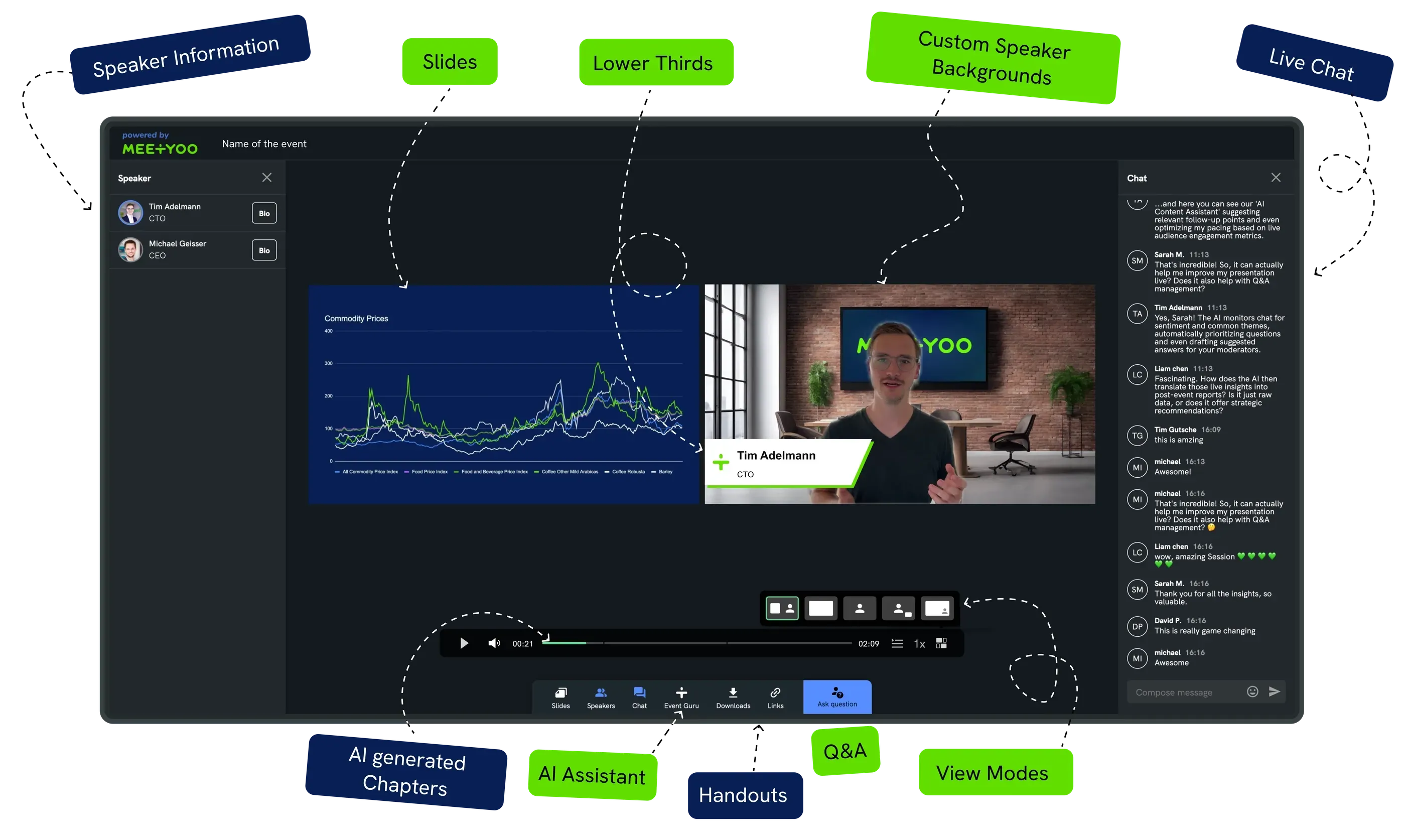
MEETYOO disappears behind your brand. Native lower thirds, virtual studios, and full CI control over the live stream are integrated directly in the platform — no external encoder, no additional technical overhead. The AI branding builder generates a complete CI theme from your website URL in seconds.
Further reading: MEETYOO branding features
Q&A management that holds up at large events
Incoming questions are automatically categorised by topic using AI. Upvoting surfaces the most relevant ones. Individual questions can be assigned directly to specific speakers. Multiple moderators can work simultaneously with clear role separation.
Even with 300 simultaneous questions, the moderation team stays in control — and the post-event Q&A analysis shows which topics genuinely engaged the audience.
Further reading: MEETYOO engagement features
Data protection without compromise — servers and operations in Germany
ISO/IEC 27001:2022-certified (TÜV), servers in Germany, developed and operated in Germany. The US CLOUD Act does not apply. DPF dependency risk is eliminated. Compliance is the starting point — not the result of a retroactive audit.
MEETYOO customers include: Commerzbank, Mercedes-Benz, Allianz GI, MRH Trowe, the Federal Office for Information Security (BSI), the German Foreign Office, SAP, and AutoScout24.
AI features that keep working after the event
Automatic chapter markers appear shortly after the event ends. Key-moment detection flags the most important passages. Chat with Webcast lets attendees ask questions directly to the video weeks later — with a timestamp link to the right moment. A webcast becomes a searchable on-demand archive with no manual post-production.
Further reading: All AI features from MEETYOO
Service on demand: production team for the moments that matter
Zoom is self-service — that is entirely appropriate for occasional internal calls. But for the CEO townhall in front of 2,000 employees or the earnings call in front of institutional investors, a different logic applies: no margin for error, no room for improvisation.
MEETYOO Show offers Service on Demand — an option Zoom simply does not have. For the events where you want to hand over responsibility, an experienced MEETYOO production team takes full ownership: setup, rehearsal, live operation, post-event asset delivery. You focus on content and audience.
That is why Commerzbank, Mercedes-Benz, and Allianz GI use MEETYOO: not only because the software is capable, but because the expert team behind the software delivers when it matters.
Analytics and multi-tenancy
Engagement data by location, department, and activity level shows where content landed — and where it did not. Different business units get their own spaces with separate templates, permissions, and brand identities.
MEETYOO vs. Zoom: direct comparison
| Requirement | Zoom Webinars | MEETYOO Show |
|---|---|---|
| CI branding on the live stream | ⚠️ External encoder required | ✅ Natively integrated |
| Full visual CI branding | ⚠️ Limited | ✅ |
| Host-side failover stream | ❌ No backup encoder | ✅ Redundant encoders |
| Q&A with AI labelling & speaker assignment | ⚠️ Upvoting, no AI labelling | ✅ |
| Searchable on-demand archive | ❌ | ✅ |
| Chat with the recording | ❌ | ✅ |
| GDPR by design, servers in Germany | ❌ US company | ✅ ISO 27001:2022 |
| Multi-tenancy | ❌ | ✅ |
| Detailed engagement analytics | ⚠️ Basic | ✅ |
| Service on demand (production team) | ❌ | ✅ |
| Scale to 1M attendees | ✅ | On request |
| CRM integrations | ✅ | ✅ |
Use cases: when the difference matters
CEO townhall (500–2,000 employees): Employees should see the company, not the platform. Failover is critical — a stream outage during the CEO address is not an IT incident, it is a communications failure. And with 200 simultaneous questions, Q&A management determines whether the event feels professional or chaotic.
Investor relations / earnings call: Stability, security, and complete archiving are non-negotiable. Investors expect broadcast quality, not video-conference aesthetics. For listed companies, GDPR-compliant data processing is a legal obligation.
Further reading: Investor Relations 2.0: How your earnings call becomes the quarter's most valuable content asset
Product launch / marketing webinar: Full CI branding for external stakeholders, lead capture with CRM integration, content repurposing for social media and follow-up campaigns. A product launch is a marketing event — it should look like the company, not the platform.
Compliance training: In pharma, financial services, and the public sector, GDPR-compliant data processing, audit-proof archiving, and tenant-separated spaces are standard requirements.
Further reading: One event, four weeks of impact
Conclusion
Zoom is a strong meeting tool — and remains the right choice as long as internal events with no external stakeholders and no branding requirements are on the agenda.
The moment a webinar needs to look professional to the outside world, a meeting architecture is no longer sufficient. CI branding, moderated Q&A at scale, GDPR-compliant data processing on German servers, production-grade failover, sustainable content reuse — these are not enterprise edge cases; they are the baseline for any event where external stakeholders are watching. MEETYOO Show is the professional webinar software made in Germany, built for exactly that standard — start free with the Forever Free Plan, all features included.
More comparisons: The 10 best webinar platforms 2026 compared
FAQ
What is the best Zoom alternative for professional webinars in Germany?
For enterprise webcasts with CI requirements and GDPR compliance, MEETYOO Show is the leading German alternative: full visual CI branding, AI-powered content reuse, servers exclusively in Germany. For a direct comparison of multiple solutions: Webinar platforms comparison 2026.
Is Zoom Webinars GDPR-compliant?
The EU–US Data Privacy Framework currently provides the legal basis for data transfer to Zoom — the EU General Court confirmed it in September 2025. However, the DPF rests on a presidential executive order from the previous US administration, and an appeal to the CJEU by NOYB remains possible. The US CLOUD Act additionally obligates US companies to hand over data on government request — even if that data is stored on EU servers. datenschutz.org summarises it plainly: "Total GDPR compliance does not exist." For organisations with strict compliance requirements, a purely European solution remains the legally safer choice.
What does Zoom Webinars actually cost?
That depends on the capacity required — and total costs typically exceed the list price significantly. Zoom Webinars is an add-on to Zoom Workplace Pro ($13.33/user/month, billed annually). Webinar capacity costs start at $66.67/month for 300 attendees. Realistic total costs: from $80/month (300 attendees), $97/month (500), $297/month (1,000), $838/month (3,000) — each plus Workplace Pro.
Which professional webinar software is made in Germany?
MEETYOO Show is developed, hosted, and operated in Germany — ISO/IEC 27001:2022-certified (TÜV), GDPR-compliant, with German-language support. For enterprise webcasts with broadcast-grade requirements, MEETYOO Show is the specialised German solution.
When is it worth switching from Zoom to a GDPR-compliant webinar platform?
Concrete triggers: external stakeholders are attending, full CI branding is required, Q&A at larger events needs moderation, attendee data must be processed exclusively within the EU, or the content needs to be reused after the live moment. Typical formats: CEO townhalls, earnings calls, marketing events with more than 500 attendees, compliance training in regulated industries.


