
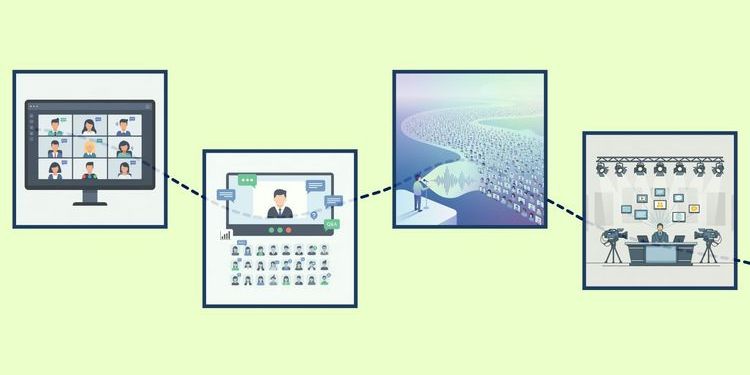
Webinar, webcast, broadcast, video conference — four terms constantly confused in B2B. The result: you book the wrong tool, the audience is frustrated, and the event underperforms its potential.
This guide settles it once and for all. You'll get precise definitions, a direct comparison of every combination, and a decision framework that tells you in five minutes which format is right for your next event.
Quick summary: The four formats at a glance
Before we go into detail, the essentials:
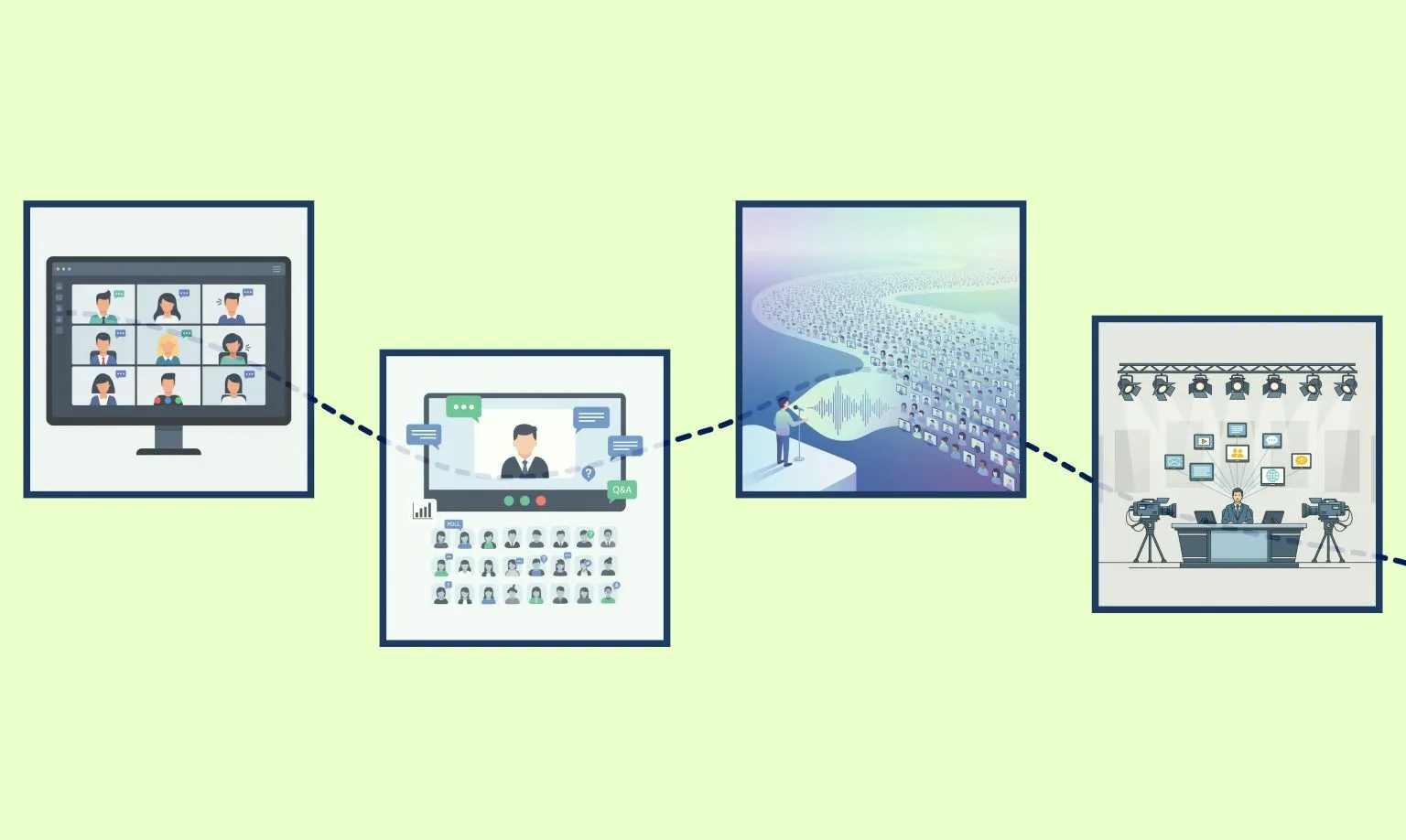
- Video conference — You speak with people. Small, interactive, collaborative.
- Webinar — You speak to people and collect structured feedback.
- Webcast — You broadcast a message to a large audience. TV quality, controlled interaction.
- Broadcast — You stream to everyone, without access restrictions. Public, scalable, studio production.
Rule of thumb: The larger your audience and the more important picture quality is, the more you need a webcast or broadcast — and the less a video conference will do.
Webinar vs. webcast: What's the difference?
This is the most common confusion — and it has real consequences for your event planning.
A webinar is an interactive online seminar. The model is "few-to-many": one or more presenters speak, the audience listens and participates actively via Q&A, polls, and chat. Webinars are ideal for training, product presentations, and lead generation — whenever you want feedback and actively control participation.
A webcast, on the other hand, is the internet equivalent of a television broadcast. The model is strictly "one-to-many". Professional quality takes centre stage: TV-grade overlays, stable connection for thousands of simultaneous viewers, complete CI branding. The audience consumes — with controlled interaction via Q&A or chat, but without actively shaping the stream.
| Feature | Webinar | Webcast |
|---|---|---|
| Audience size | 50–1,000+ | 1,000–50,000+ |
| Interactivity | Medium to high | Low to controlled |
| Production quality | Professional | TV quality |
| Typical use case | Training, lead gen | CEO town hall, IR, product launch |
| Access control | Registration | Registration or SSO |
When webinar, when webcast? If you're training a few hundred people or generating leads — webinar. If your CEO is presenting to 3,000 employees or investors and you can't risk any quality issues — webcast.
Webcast vs. web conference: What's the difference?
"Web conference" and "webcast" sound similar, but are fundamentally different.
A web conference is a structured online conference with active participation from all parties — closer to a video conference than a broadcast. Everyone sees each other, everyone can speak. The model is collaborative.
A webcast is not a conference — it's a transmission. Only presenters are visible and active. The audience watches. The technology is optimised for stability with large audiences, not for two-way communication.
In short: Web conference = everyone talks to each other. Webcast = one person broadcasts professionally to many.
For companies running internal events like CEO town halls, earnings calls, or compliance training, the webcast is the right format — because it guarantees the scaling, stability, and professional branding that a web conference cannot deliver.
Webcast vs. video conference: When is each enough?
The line between video conference and webcast often comes down to one question: Does my audience need a voice — or does it need a message?
A video conference (Zoom, Teams, Meet) is built for collaboration. Every participant has equal audio and video access. That works perfectly up to 20–30 active participants. Beyond that it gets chaotic: background noise, bandwidth issues, no moderation.
A webcast is built for exactly the opposite: large audiences, controlled flow, professional production. Presenters are on "stage", the audience is in viewer mode — with the ability to interact via Q&A and polls, but without disrupting the stream.
Practical example: A weekly team meeting for 15 people? Video conference. A company-wide all-hands for 2,000 employees? Webcast — otherwise you risk chaos, connection drops, and a CEO waiting on camera.
Webcast vs. live stream: What's the difference?
These two terms often describe the same thing — but with an important difference in access and context.
A live stream is technically any real-time video transmission over the internet. The term is used primarily for public streams — on YouTube, LinkedIn Live, Instagram, or Twitch. No login, no registration form, no access control.
A webcast is typically an access-restricted, professionally produced stream — with registration, GDPR-compliant participant management, CI branding, and detailed analytics. The webcast is the enterprise standard for corporate communication; the live stream is the channel for public visibility.
Many companies combine both: they produce a professional webcast for registered participants and simultaneously send a simplified live stream to LinkedIn or YouTube for maximum reach.
→ Explore MEETYOO branding and CI-compliant webcast setups
Webinar vs. video conference: The most common mistake in organisations
Many companies run large webinars as simple video conferences — and then wonder why there's chaos, poor quality, and a disengaged audience.
The difference is in the architecture:
A video conference gives every participant a microphone and camera. With 200 participants, that means 200 potential sources of disruption. There's no stage control, no professional branding, and no way to truly moderate the flow.
A webinar tool separates stage and audience. Presenters are visible and active; the audience interacts through controlled channels. The moderator has full control over Q&A, polls, and the entire event flow — without the risk of interruptions.
Tip for event managers: Once your participant count exceeds 50, or external stakeholders are involved (customers, investors, partners), you no longer need a meeting tool — you need an event platform.
Broadcast: When is studio-grade production the right format?
A broadcast in a B2B context goes a step further than a webcast: it's designed for maximum production quality — multiple camera angles, professional lighting, lower thirds, studio setup — and is often streamed simultaneously to multiple platforms (simulcasting).
Broadcasts are suited for:
- Large brand activations and product launches aimed at public visibility
- Keynotes and conference main stages streamed live to social media
- Events where maximum reach (not access control) is the goal
For corporate communication with compliance requirements, access control, and GDPR-compliant participant management, the professional webcast remains the superior choice.
→ Explore MEETYOO AI features for webcasts and on-demand content
Comparison: Key differences at a glance
Decision framework: Which format is right for you?
Identify your primary goal — and the answer follows almost automatically.
Choose a video conference when:
- You need to make decisions, solve problems, or brainstorm as a team
- The group is manageable (under 20–30 active participants)
- You want everyone to be heard and seen
Choose a webinar when:
- You're training an audience or presenting a product
- You want to capture lead data (registration required)
- You want structured engagement (Q&A, polls) — but you keep control
Choose a webcast when:
- You're hosting a company-wide event with high visibility (CEO town hall, investor relations, product launch)
- Your audience exceeds the capacity of meeting tools (1,000+)
- Image quality, stability, and CI branding are critical
- GDPR compliance and access control are non-negotiable
Choose a broadcast when:
- Maximum public visibility is your goal
- You're producing a studio-quality event with multiple cameras
- The content is meant for public consumption (no login, no registration)
Conclusion
All four formats use video over IP — but they serve fundamentally different functions:
- Video conference — talk with each other, collaborate
- Webinar — present to people and collect structured feedback
- Webcast — scale a message to a large audience with TV quality and enterprise security
- Broadcast — distribute high-end content publicly
For most business-critical events — CEO town halls, investor relations, compliance training, external product presentations — the professional webcast is the right format. It combines the reach of a broadcast with the structure of a webinar and the security enterprise companies need.
MEETYOO Show is built for this: Made in Germany, ISO 27001 certified, with complete CI branding and AI features that turn every live event into a permanent content asset.
FAQ
What is the difference between a webinar and a webcast?
A webinar is an interactive online seminar with controlled participation (Q&A, polls, chat) for typically 50–1,000 participants. A webcast is a professional internet transmission in TV quality for large audiences (1,000–50,000+), where the audience is in viewer mode. Webinars suit training and lead generation; webcasts suit CEO town halls, investor relations, and high-quality corporate communication.
What is the difference between a webcast and a web conference?
A web conference is a collaborative online meeting where all participants can actively speak and be seen — similar to a video conference. A webcast is a one-way transmission: presenters broadcast, audience watches. Web conference = everyone talks to each other. Webcast = one person broadcasts professionally to many.
What is the difference between a webcast and a live stream?
Technically, a live stream is any real-time video transmission. A webcast is an access-restricted, professionally produced stream with registration, GDPR-compliant participant management, and CI branding. A live stream typically runs publicly on platforms like YouTube or LinkedIn — without access control.
When is a video conference enough — and when do I need a webcast?
A video conference works for collaborative meetings up to around 20–30 active participants. Once your audience grows larger, external stakeholders are involved, or professional branding and stable quality become critical, you need a dedicated event platform. The threshold is often 50+ participants and external audiences (customers, investors, partners).
Can I run a webinar as a webcast?
Yes — modern platforms like MEETYOO Show support both formats. You can run an event with high interactivity (webinar mode) just as easily as a TV-grade broadcast with a controlled audience (webcast mode). The platform adapts to your communication goal, not the other way around.
Which platform is best for professional webcasts in Germany?
For enterprise webcasts in Germany, MEETYOO Show is the leading solution: Made in Germany, ISO 27001 certified, GDPR compliant, with complete CI branding, AI features for content ROI, and German-speaking support. Trusted by Commerzbank, Mercedes-Benz, SAP, and Allianz GI.


