

Measuring webinar ROI accurately is one of the most underrated tasks in B2B marketing. 400 registrations, 210 live attendees: sounds solid. But does it justify next quarter's budget? Most marketing and event teams measure what's easy to capture. The result: webcasts get labelled expensive and hard to measure internally. They're actually among the most cost-efficient lead generation channels in B2B — when you track the right numbers.
Why webinar ROI is so often measured wrong
The problem starts with the wrong questions. Teams track registration numbers, attendance rate, average session duration. These are vanity metrics: easy to collect, rarely actionable.
A webinar with 800 registrations and 12% conversion to qualified leads almost always beats a webinar with 200 registrations and 40% conversion in raw lead volume. Whoever only looks at registration numbers draws the wrong conclusion.
There's also a structural challenge: webinar data in most companies is spread across three to four tools. Webcast platform, CRM, marketing automation, Google Analytics. Without a unified data foundation, real ROI calculations remain guesswork.
If you run webcasts with meeting tools like Teams or Zoom, you don't have reliable analytics to begin with. Enterprise webcast platforms deliver the raw data you need for accurate ROI calculation.
The three layers of webinar ROI
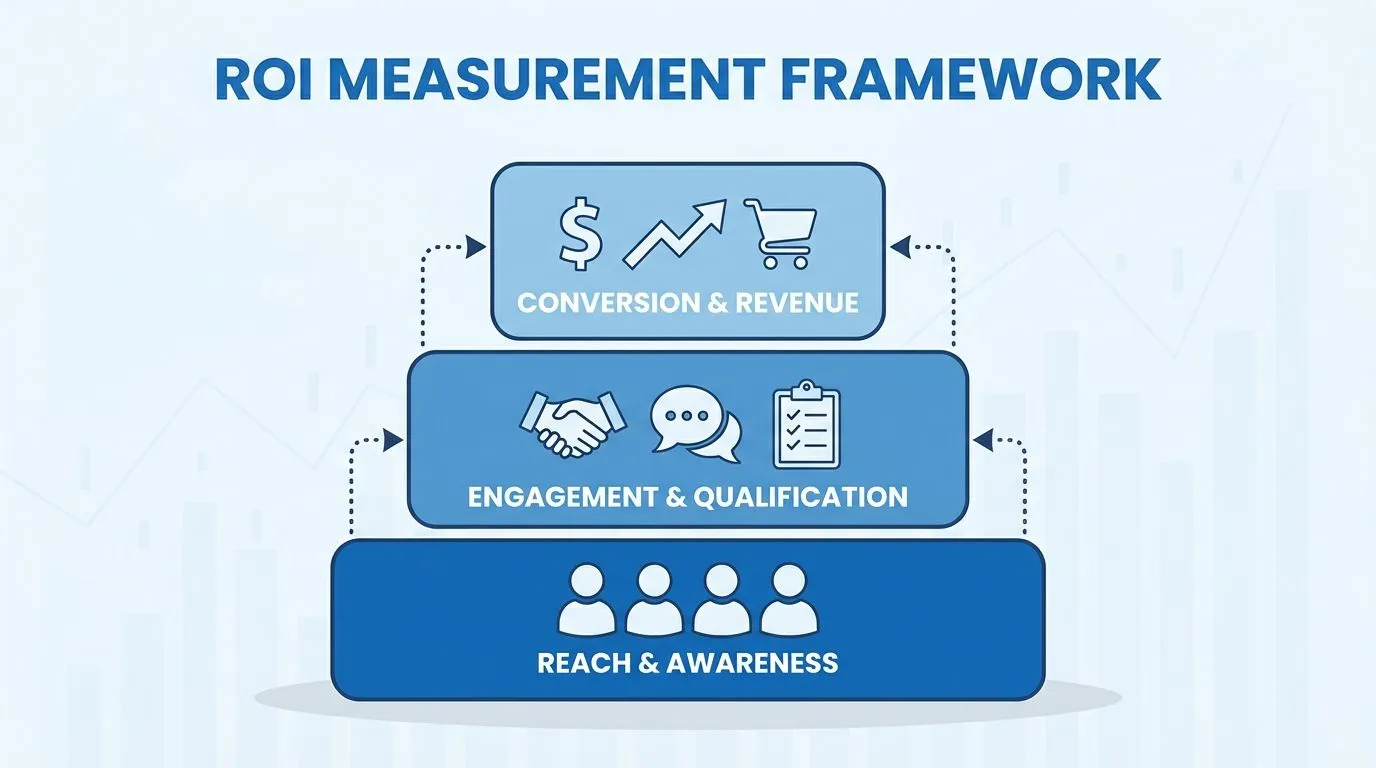
Before diving into individual KPIs, it helps to think of ROI in three layers:
Layer 1: Reach & Awareness How many of the right people did you reach?
Layer 2: Engagement & Qualification How deeply did they engage with your content?
Layer 3: Conversion & Revenue What did the webinar concretely contribute to business results?
Most teams measure intensively at Layer 1 and almost nothing at Layer 3. That leaves the most important part of the story untold.
The KPIs that actually matter
Layer 1: Reach
Registration-to-attendee rate (show-up rate) Industry benchmark: 35–55%. If yours is lower, that typically signals a weak topic, poor timing, or an inadequate reminder sequence.
Reach mix: live vs. on-demand Many B2B professionals prefer to consume webinar content on demand rather than attend live. Teams that only count live attendees significantly underestimate their actual reach. Measure both separately.
Layer 2: Engagement
Engagement rate The proportion of attendees who interacted actively: polls, Q&A, chat. As a rough guideline, a rate below 20% is worth investigating — either the topic or the interaction format may need adjusting. Passive viewers convert less often.
Drop-off curve When do attendees leave? A sharp exit at minute 18 tells you exactly where a content break occurs.
Q&A question quality How many questions were asked? Which topics repeat? This is qualitative gold for your content team and sales organisation.
Pro tip: MEETYOO automatically analyses Q&A questions with AI, including smart labels like "Priority", "Technical", or "Feedback". You see at a glance which topics your audience actually cares about, without scrolling through dozens of questions manually.
→ Explore all engagement features
Layer 3: Conversion & Revenue
Lead-to-opportunity rate How many webinar registrations become qualified sales conversations? This is the most direct line from webinar to revenue.
Cost per qualified lead (CpQL) The formula:
CpQL = (Total webinar costs) ÷ (Number of qualified leads)
Total costs include: platform licence, preparation time (hours × day rate), promotion budget, speaker time.
Marketing influenced revenue What proportion of quarterly revenue was influenced by leads who attended a webinar? This number is your strongest argument in any budget conversation.
Content reach beyond the event How many times was the recording accessed on demand? How many assets were generated from the webinar content (blog posts, social clips, whitepapers)? This long tail is systematically undervalued.
Webinar ROI: the core formula
Webinar ROI (%) = (Marketing Influenced Revenue – Webinar Costs) ÷ Webinar Costs × 100
A practical example: A webinar costs €3,500 (platform, preparation, promotion). It generates 28 qualified leads, of which 4 become customers within 90 days. At an average contract value of €12,000, that's marketing influenced revenue of €48,000.
ROI = (48,000 – 3,500) ÷ 3,500 × 100 = 1,271%
Even if you only attribute 30% of revenue to the webinar: the result convinces any CFO.
Best practices for webinar measurement
Define KPIs before the event, not after What counts as success? Agree this with your sales team ideally one week before the event. This prevents post-hoc rationalisation.
Connect your webcast platform to your CRM Webinar engagement data only becomes actionable when it lands in your CRM. "This person asked two questions and watched until the end" is a lead score, not a loose data point sitting in the platform.
Measure on-demand separately from live Separate reporting shows whether your topic stays relevant over time — an important signal for your content strategy.
Run a post-event debrief 30 minutes with the event team and sales: What did we learn? Which questions came up repeatedly? What would we do differently next time?
Pro tip: MEETYOO's automatically generated chapters and key-moment highlights give you a solid debrief foundation. You see at a glance which topics drove the most interaction, without rewatching the entire recording.
How AI speeds up webinar measurement
Manual analysis of a 60-minute webcast easily takes an experienced team 3–4 hours: rewatching the recording, categorising Q&A questions, exporting engagement data, writing a report. MEETYOO automates these steps:
Automatic chapter generation Topic-based chapters appear minutes after the session ends. You immediately see which segments drove the most engagement.
Key-moment detection The AI flags moments of high interaction, notable speaker emphasis, or engagement spikes. Your highlight reel is already pre-structured.
Chat with Webcast You and your attendees can ask questions in natural language after the event. "When was data privacy discussed?" delivers the timestamp and a deep-link directly to that moment.
Smart Q&A labels Automatic tagging of all submitted questions by priority, topic, and type. This delivers directly usable insights for your content team.
Webinar ROI by use case
| Use Case | Primary ROI Goal | Typical CpQL |
|---|---|---|
| Marketing webinar (lead gen) | Qualified leads | €40–120 |
| CEO townhall (internal comms) | Engagement score, retention | Cost avoidance vs. in-person |
| Product launch | Demand generation, trial starts | Depends on ACV |
| Partner webinar | Pipeline contribution | Indirectly measurable |
| Compliance training | Completion rate, audit trail | Cost avoidance |
Webinar leads cost less in practice than leads from trade shows or paid search. The reason is structural: high fixed costs per event, but very low marginal cost per additional lead. The more you extract from one production — through on-demand, repurposing, and follow-up — the cheaper each individual lead becomes.
Common mistakes and how to avoid them
Only counting live attendees On-demand views can significantly increase actual reach. Ignoring them systematically understates ROI.
No CRM integration Without data transfer to your CRM, every lead score is manual work and many leads simply fall through the cracks.
Attribution windows that are too short B2B sales cycles run weeks to months. Measuring webinar ROI after two weeks almost always produces a negative result.
Not repurposing webinar content The recording, the transcript, the Q&A collection: all of this is content. Teams that don't use it systematically waste the largest part of their content ROI.
Conclusion
Webinar ROI is measurable, but only if you ask the right questions and collect the right data. The three most important steps: define KPIs before the event, ensure CRM integration, include on-demand reach in your calculations. With MEETYOO, AI handles the bulk of the data work.
FAQ
How do I calculate the ROI of a webinar?
Basic formula: (Marketing Influenced Revenue – Webinar Costs) ÷ Webinar Costs × 100. Costs include platform licence, preparation time, and promotion budget. Revenue is the income influenced by webinar leads, typically attributed at 20–50%.
What's a good show-up rate for B2B webinars?
35–55% is a solid B2B benchmark. Lower rates usually point to the reminder sequence (too few emails, wrong timing) or a topic that's too generic.
How long should I measure webinar attribution?
At least 90 days post-event. In sectors with long sales cycles — financial services, pharma — 6–12 months is more appropriate.
What's the difference between a KPI and a vanity metric in webinar context?
Vanity metrics are easy to collect but rarely actionable: registration numbers, average session duration. KPIs connect directly to business goals: cost per qualified lead, lead-to-opportunity rate, marketing influenced revenue.
Can I measure webinar ROI for internal events too?
Yes, but the benchmark is different. For CEO townhalls or compliance training, ROI is often cost avoidance compared to an in-person event, or measurable engagement scores like survey results and course completion rates.
How does AI help with webinar measurement?
AI features like automatic chapter generation, key-moment detection, and smart Q&A labels significantly reduce manual analysis effort. MEETYOO offers these natively, including "Chat with Webcast".
How much does a qualified webinar lead cost compared to other channels?
Webinar leads are cheaper in practice than leads from trade shows or paid search, because marginal cost per additional lead after the initial production investment is very low. No universal industry figure exists — the difference depends heavily on sector, topic, and how thoroughly you measure and repurpose.


